
 eng
eng
 укр
укр
 рус
рус
A safe job search abroad starts with checking the employer or recruitment agency. A job offer should clearly state the country and city, company name, job responsibilities, work schedule, pay, type of employment contract, accommodation conditions, and any possible payroll deductions. Never transfer money to the personal bank accounts of strangers or hand over your original passport to third parties. Before leaving, obtain the employment terms in writing, verify the company's contact details, and keep copies of all documents. A reliable job abroad means legal employment, a clear contract, and the opportunity to ask the employer all important questions before your trip.
Legal hotel room attendant and housekeeper jobs in Poland in 2026 should come with clearly defined duties, a written contract before work begins, and pay that complies with the rules applicable to the type of contract. Before applying, check the employer or employment agency, accommodation and deductions, working hours, time-recording arrangements, and the documents that give you the legal right to work in Poland. Read More
Hotel Housekeeper
5000 – 7500 PLN
- USD ≈ 1415 - 2122
- EUR ≈ 29167 - 43750
- CZK ≈ 33654 - 50481
- UAH ≈ 61250 - 91875
25 - 31.40
PLN / hr
- Szklarska Poręba
- Rotating work schedule, 8 - 10 hours per day
- 600 zł/month
- Free Vacancy
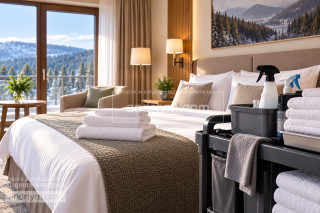
The mountain hotel and sports complex provides comfortable accommodation, restaurant services, SPA facilities, and opportunities for active recreation.
Frequently Asked Questions
The required documents depend on the country, the applicant's citizenship, profession, and legal basis for residence. In most cases, working abroad requires a valid passport, proof of legal stay, a work permit or another legal basis for employment, and an employment contract. Some professions may also require diplomas, certificates, or medical documents. Before travelling, confirm the requirements for your specific job offer and check that all documents remain valid. Do not agree to work without official documentation, as legal employment protects your rights to fair pay, rest periods, insurance, and safe working conditions.
Ask for the employer's full legal name, address, registration details, job description, and a draft of the employment contract. Compare the information in the job offer with the contract, including the hourly or monthly pay, working hours, bonuses, accommodation, transportation, and all possible deductions. Check the company's website, independent reviews, and contact details, but remember that reviews alone are not a substitute for official documents. Be cautious if you are promised unusually high earnings with no requirements, pressured to make immediate payments, or refused information about the employer. A trustworthy job offer provides clear conditions and allows you to receive written confirmation before making a decision.
Before travelling, check your passport, documents required for legal residence and employment, your contract, accommodation address, and the contact details of the responsible coordinator. Make both digital and printed copies of your documents, arrange the necessary insurance, and prepare a financial reserve for the first few weeks. Find out your travel route, accommodation check-in rules, transportation costs, work clothing requirements, and the date of your first shift in advance. Share your accommodation address and employer's contact details with your family or trusted contacts. Good preparation reduces the risk of unexpected expenses and helps you start working in a new country with confidence.
Reviews about the work
Доброго дня. Я працювала прибиральницею в фітнес центрі у Варшаві. Мені дуже сподобалася дана робота. Зарплатня мене дуже приємно здивувала це було 14 злотих в годину. Але найбільше мені сподобалося те що була можливість займатися в тренажерному залі і підтримувати в тонусі своє тіло. Рекомендую дану працю.
Доброго дня. Мені 49 років. Нещодавно приїхала з Польщі, працювала там прибиральницею на великому підприємстві в офісі. Робота не складна, в основному полягала у підтриманні чистоти в приміщенні протягом робочого дня (два рази на день вологе прибирання місць загального користування, сходів та коридорів, приготування мийних та дезінфікуючих розчинів) Проживанням забезпечував роботодавець, а от харчування за власний рахунок. Зарплата 15 злотих за годину. Робота не легка, але вища освіта, знання мови для її виконання не потрібне. Головне, що потрібне – це бажання працювати. Особисто я задоволена!
Привіт. Працювала в Польщі прибиральницею. Беруть до 50 років. Потрібно прибирати склади і кабінети начальства. Всі матеріали та засоби прибирання надаються. Також є маленька підсобка. Платили 13 злотих чистими. 8 годин на день. Можна працювати більше. Житло надають безкоштовно. Харчування за свій рахунок. В цілому робота нормальна. Зарплата точно більша чим в Україні.
Hotel Room Attendant and Housekeeper Jobs in Poland in 2026: Vacancies, Pay, Duties and Legal Employment
Where hotel room attendants and housekeepers work in Poland
Hotel room attendant and housekeeper jobs in Poland in 2026 are primarily available in hotels, aparthotels, guesthouses and other accommodation properties. Working conditions vary depending on the type and size of the property, location, season, room occupancy and internal housekeeping standards. Before accepting a job, establish who will actually be a party to your contract: the hotel itself, a cleaning company or an employment agency.
A hotel room attendant or housekeeper should not be confused with a private domestic worker or caregiver. In a hotel, the core role is to prepare guest rooms and maintain cleanliness in designated areas of the property. Cooking for a private household or caring for children, an older person or pets are different types of work. If an employer wants to combine these functions, the additional duties, working time and pay should be agreed separately in the contract.
Duties of a hotel room attendant or housekeeper
Typical duties include cleaning the bedroom and bathroom, making beds and changing bed linen, replacing towels according to the property's standards, removing waste, wiping surfaces, vacuuming or mopping floors, and replenishing the guest supplies and amenities provided by the hotel. A room attendant normally works with a housekeeping trolley, cleaning equipment and professional cleaning products and should follow the property's procedures for their safe and correct use.
Duties may also cover corridors, stairways, lift areas and other designated common areas. Work in a laundry or linen room, including sorting, moving or preparing linen, should form part of the role only when it is included in the position or separately agreed with the employer. The scope of additional duties is best clarified before signing the contract rather than after starting work.
Guest room cleaning and confidentiality standards
Cleaning a room after a guest checks out usually differs from servicing an occupied room during a stay. A checkout room may require a complete change of bed linen and towels, thorough bathroom cleaning, surface cleaning, a check of room supplies and preparation for the next arrival. For an occupied room, the scope of service depends on the hotel's standards, the guest's requests and the property's rules governing staff access to rooms.
A room attendant should not take, discard or move a guest's belongings contrary to the hotel's established procedures. Lost or forgotten property, damaged furniture, equipment, plumbing fixtures or other problems should be reported to the responsible member of staff according to internal procedures. Confidentiality is part of professional housekeeping: staff should not photograph guests' personal belongings, disclose information about their stay or discuss what they see in a room beyond what is necessary for their work.
Room quotas and cleaning time
There is no universal rule that every housekeeper in Poland must clean a fixed number such as 20 or 30 rooms per shift. The number of assigned rooms and the time available per room depend on room size, hotel category, cleaning standard, occupancy, the condition of the room and whether the task is a checkout clean or stayover service. Candidates should ask the employer to specify in writing the expected room quota, how it is calculated and what procedure applies when the actual workload cannot reasonably be completed within scheduled working time.
If payment is offered per room cleaned, ask in writing for the rate, the tasks included in that amount and the method used to record actual working hours. Piece-rate or per-room payment should not be used to disguise remuneration below a statutory minimum where the applicable minimum-pay rules cover the particular contract.
Hotel housekeeper pay in Poland in 2026
Pay stated in a vacancy should be assessed together with the type of contract, the number of paid hours and the rules used to calculate remuneration. From 1 January 2026, the statutory minimum for full monthly working time under an employment relationship based on an umowa o pracę is PLN 4,806 gross per month. For civil-law contracts covered by the statutory minimum hourly-rate rules, including typical umowa zlecenie arrangements, the minimum rate in 2026 is PLN 31.40 gross per hour. Current statutory figures can be checked on the official Polish public employment services website.
Gross pay is not the same as the amount received in a bank account or taken home. Net pay depends on the type of contract, social insurance contributions, taxes, the number of hours worked, the worker's individual circumstances and any applicable additional payments. A properly described vacancy should therefore make clear whether a quoted amount is gross or net. Candidates should not estimate monthly earnings simply by multiplying an advertised hourly rate by the maximum number of hours they assume they will be offered.
Working hours, days off, public holidays and tips
There is no single standard schedule for hotel room attendants. Shift start and finish times, the number of working days, days off and work on weekends or public holidays depend on the contract, the applicable working-time arrangements and the operational needs of the property. Before accepting a position, ask how schedules are planned, what breaks apply, how working time is recorded, how schedule changes are handled and how work attracting additional statutory or contractual payments is compensated.
Tips may occur in the hotel industry, but they should never be treated as a guaranteed part of earnings or used to justify low basic pay. Expected monthly earnings should likewise not be based on an assumption that additional or overtime hours will always be available.
Experience and Polish-language requirements
Some vacancies are open to applicants without previous housekeeping experience if the employer provides induction and on-the-job training. Previous hotel housekeeping experience can be an advantage, particularly at properties with detailed service and quality standards. The required level of Polish depends on the position: some roles may require only the ability to understand instructions and basic workplace phrases, while others involve more confident communication with supervisors, reception staff or guests. Requirements for English or another language also depend on the individual hotel and are not universal across the occupation.
Cleaning quality and the room checklist
Professional room cleaning follows the standards of the individual property rather than relying only on whether a room looks clean at first glance. An employer may use a room checklist covering the condition of the bed and linen, cleanliness of the bathroom, mirrors, surfaces and floors, the correct set of towels, required guest supplies, waste removal and overall readiness for the next guest. Workers should ask to see the applicable standard and inspection criteria during training.
If a room does not pass a quality inspection, the employee should know the procedure for correcting the issue and who performs the inspection. Unrealistic demands for both very high speed and a large workload without regard to the required quality standard should be raised with the supervisor, particularly if meeting the assigned quota repeatedly requires work outside recorded working time.
Written contract before starting work
A foreign worker must have a written contract before starting work, and the employer must provide the worker with a copy of the concluded contract. If the worker does not understand Polish sufficiently, the written content of the contract must be presented before signing in a language version the worker understands. General official information on the legal employment of foreign workers is provided by the Polish National Labour Inspectorate.
Before signing, check the employer's name, job title, place of work, type of contract, gross remuneration, working-time recording rules, start date and other material conditions. Do not agree to begin ordinary work informally as an unpaid or undocumented “trial” where you are in practice performing regular duties for the employer.
Accommodation, meals, workwear and deductions
Accommodation, meals, transport to the workplace and workwear are not automatically free simply because a vacancy is offered to a foreign worker. If an employer or agency provides accommodation, ask before travelling for the location or address, cost, number of people sharing a room, utility charges, any deposit, rules for leaving the accommodation and whether the right to stay there is tied to the employment relationship.
Any proposed deductions from pay for accommodation, meals, transport, workwear or other services should be clarified before documents are signed, including their contractual and legal basis. The phrase “accommodation provided by the employer” does not by itself mean that the accommodation is free of charge.
Health and safety, cleaning chemicals and physical workload
Hotel housekeeping involves prolonged periods on your feet, repetitive movements, bending, moving a housekeeping trolley and working with surface-cleaning products. Workers should receive the health and safety instruction required for their work, known in Poland as BHP, and understand the rules for using cleaning chemicals, including dosing, labelling and what to do if a product comes into contact with the skin or eyes.
The employer should organise work in accordance with the applicable health and safety requirements. Depending on the risk assessment and specific duties, appropriate personal protective equipment may be required, including gloves. Proper working technique, ergonomic handling of equipment and adherence to procedures rather than unsafe rushing can help reduce physical strain and workplace risks.
Documents and legal employment of a foreign worker in Poland
As of 14 August 2026, a foreign worker should separately verify both the legality of their stay in Poland and the legal basis giving them access to the Polish labour market before starting work. Not every form of lawful stay automatically gives a person the right to work. The required employment mechanism and documentation depend on the worker's status, basis of stay, nature of the work and the rules in force at the time of employment.
The legal-employment procedure cannot be selected arbitrarily, nor should one document be treated as interchangeable with another simply because it appears easier to obtain. Before starting work, establish whether your particular basis of stay permits employment, whether an additional procedure or document is required and who is responsible for completing the relevant formalities. General official requirements concerning the legal employment of foreign workers and employers' obligations should be checked on the Polish National Labour Inspectorate's legal-employment portal.
How to check a vacancy, the agency in KRAZ and the terms before applying
If an employment agency offers the vacancy, check its details in the Krajowy Rejestr Agencji Zatrudnienia — KRAZ, Poland's register of employment agencies. Compare the entity's name and identification details with those stated in the vacancy or contract, and check whether the registration is active and what type of services the entry covers. A similar company name alone does not prove that the person contacting you represents the registered entity.
Before providing documents, establish the future employer's full name, the actual workplace address, who will pay your wages and which entity will be a party to your contract. Before accepting the offer, ask in writing: what type of contract is offered; what the gross rate is; how and when wages are paid; how working time is recorded; what the typical schedule is; what room quota applies; how quotas differ between checkout and stayover rooms; whether payment per room is used and how it relates to recorded hours; which common areas are included; whether laundry or linen-room duties are required; who supplies cleaning equipment, workwear and necessary protective equipment; whether accommodation is available and what it actually costs.
Red flags include missing or unclear employer details, refusal to provide the contract before arrival, repeated changes to agreed terms, refusal to provide conditions in writing, a demand to start work without a contract, a rate that does not specify whether it is gross or net, undisclosed deductions, promises of guaranteed tips or continuous overtime, failure to record working hours, replacing hotel housekeeping duties with caregiving or other duties that were not agreed, and pressure to sign documents you do not understand immediately. Editorial note: the legal information and statutory minimum rates on this page were checked on 14 August 2026. Before applying, check the current minimum rates, legal-employment rules for foreign workers and your own basis of access to the Polish labour market again using official government sources.
