
 eng
eng
 укр
укр
 рус
рус
A safe job search abroad starts with checking the employer or recruitment agency. A job offer should clearly state the country and city, company name, job responsibilities, work schedule, pay, type of employment contract, accommodation conditions, and any possible payroll deductions. Never transfer money to the personal bank accounts of strangers or hand over your original passport to third parties. Before leaving, obtain the employment terms in writing, verify the company's contact details, and keep copies of all documents. A reliable job abroad means legal employment, a clear contract, and the opportunity to ask the employer all important questions before your trip.
Hotel jobs in Poland in 2026 include housekeeping, front desk, restaurant, kitchen, laundry, technical services, SPA and other hospitality roles. As of August 2026, before accepting a job you should verify the employer, contract type, guaranteed working hours, gross pay, schedule, accommodation and the legal basis for lawful employment. From 1 January 2026, the minimum wage for full-time employment under an umowa o pracę is PLN 4,806 gross per month, while the minimum hourly rate for civil-law contracts covered by the statutory minimum is PLN 31.40 gross per hour. Read More
Cook at a hotel complex
8800 – 10600 PLN
- USD ≈ 2490 - 2999
- EUR ≈ 51333 - 61833
- CZK ≈ 59231 - 71346
- UAH ≈ 107800 - 129850
34
PLN / hr

- Osiedle Wilga
- Flexible work schedule, 12 hours/day
- 600 zł/month
- Free Vacancy
A hotel and restaurant complex offering accommodation, dining, leisure, and various event organization services.
Hotel Housekeeper
5000 – 7500 PLN
- USD ≈ 1415 - 2122
- EUR ≈ 29167 - 43750
- CZK ≈ 33654 - 50481
- UAH ≈ 61250 - 91875
25 - 31.40
PLN / hr
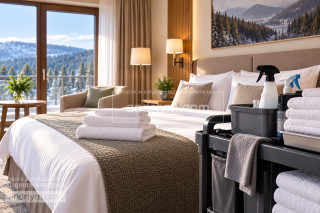
- Szklarska Poręba
- Rotating work schedule, 8 - 10 hours per day
- 600 zł/month
- Free Vacancy
The mountain hotel and sports complex provides comfortable accommodation, restaurant services, SPA facilities, and opportunities for active recreation.
Housekeeper at a hotel complex
4400 – 6100 PLN
- USD ≈ 1245 - 1726
- EUR ≈ 25667 - 35583
- CZK ≈ 29615 - 41058
- UAH ≈ 53900 - 74725
25.36 - 31.40
PLN / hr
- Dziwnówek
- Rotating work schedule
- 300 zł/month
- Free Vacancy
The hotel complex on the Baltic Sea coast provides comfortable accommodation, restaurant services, a wellness area, and a wide range of services for family and active holidays.
Frequently Asked Questions
The required documents depend on the country, the applicant's citizenship, profession, and legal basis for residence. In most cases, working abroad requires a valid passport, proof of legal stay, a work permit or another legal basis for employment, and an employment contract. Some professions may also require diplomas, certificates, or medical documents. Before travelling, confirm the requirements for your specific job offer and check that all documents remain valid. Do not agree to work without official documentation, as legal employment protects your rights to fair pay, rest periods, insurance, and safe working conditions.
Ask for the employer's full legal name, address, registration details, job description, and a draft of the employment contract. Compare the information in the job offer with the contract, including the hourly or monthly pay, working hours, bonuses, accommodation, transportation, and all possible deductions. Check the company's website, independent reviews, and contact details, but remember that reviews alone are not a substitute for official documents. Be cautious if you are promised unusually high earnings with no requirements, pressured to make immediate payments, or refused information about the employer. A trustworthy job offer provides clear conditions and allows you to receive written confirmation before making a decision.
Before travelling, check your passport, documents required for legal residence and employment, your contract, accommodation address, and the contact details of the responsible coordinator. Make both digital and printed copies of your documents, arrange the necessary insurance, and prepare a financial reserve for the first few weeks. Find out your travel route, accommodation check-in rules, transportation costs, work clothing requirements, and the date of your first shift in advance. Share your accommodation address and employer's contact details with your family or trusted contacts. Good preparation reduces the risk of unexpected expenses and helps you start working in a new country with confidence.
Reviews about the work
Я працював адміністратором готелю в Гданську. Мені дуже сподобалася дана робота так як я знав польську мову і мав досвід праці в готелях. Завдяки своєму бажанні заробити я зміг вийти на достойний рівень заробітної плати. Бажаю успіху усім хто працює в схожих сферах.
Доброго дня. Працювала в готелі в Польщі в м. Вроцлав. Робота полягала в заміні рушників та постільної білизни. За місяць заробляла 3000-3500 злотих. Жила в будиночку для обслуговуючого персоналу біля готелю. Умови хороші і дуже пристойні, все чистеньке і нове. Знання мови не важливе. Проживання безкоштовне, а харчування по цінах для працівників. Вихідні дні можна також погодити. Загалом я задоволена і роботою ставленням до працівників!
Працювала покоївкою в готелі в Слупську. Беруть до 45 років. Прибирала номери. Робочий графік 8- 10 годин. 2 робочі суботи 2 робочі неділі. Чергуються між собою. Робота не пильна, але бувають такі гості, що то жесть. Зарплата 3000 в місяць приблизно + чаєві від гостей.
Hotel jobs in Poland in 2026: vacancies, pay, contracts and legal employment
As of August 2026, Poland’s hotel sector offers a wide range of jobs, from room cleaning and kitchen support to front desk work, restaurant service, technical maintenance and SPA positions. Conditions vary considerably by city, hotel category, role, employer and contract type, so a vacancy should be assessed on specific terms rather than on the advertised earnings alone.
What hotel jobs are available in Poland
Typical hotel roles include pokojowa or housekeeping staff, receptionist or front desk agent, breakfast staff, waiter, bartender, kitchen helper, dishwasher, laundry staff, porter, maintenance or technician roles, and SPA/wellness staff. A job title alone does not define the full scope of duties, so you should obtain a written description of responsibilities before signing a contract.
- Housekeeping / pokojowa: cleaning guest rooms and bathrooms, changing bed linen and towels, replenishing hotel-provided amenities, cleaning common areas and reporting damage or lost-and-found items.
- Receptionist / front desk: handling check-in and check-out, managing reservations and PMS tasks, communicating with guests, processing payments and cash transactions within the role’s authority, handling documents and working with guests’ personal data.
- Breakfast staff: preparing the breakfast area, setting out and replenishing food, clearing tables and following food-safety procedures.
- Waiter / bartender: taking orders, serving food and drinks, using a POS system or cash register, preparing the service area and settling guest bills according to internal procedures.
- Kitchen helper: food-preparation support, assisting cooks and keeping equipment and work surfaces clean.
- Dishwasher: washing dishes and kitchen equipment and keeping the assigned work area clean.
- Laundry: sorting, washing, drying, ironing, folding and distributing hotel textiles in line with internal procedures.
- Porter: helping with luggage and carrying out other guest-service duties defined by the hotel.
- Maintenance / technician: inspecting equipment, carrying out minor technical work within the limits of the employee’s qualifications, recording faults and either fixing them or referring them to specialist contractors.
- SPA/wellness: duties depend on the specific profession; certain treatments may require appropriate professional qualifications or documents.
Housekeeping and pokojowa jobs: what to check before starting
For housekeeping, the wording “room cleaning” is not detailed enough. You should ask in writing whether the role includes rooms after check-out, occupied rooms, corridors and other common areas, changing bed linen, using a housekeeping trolley and moving hotel textiles.
Hotels may use internal workload targets, but there is no valid basis for stating one universal number of rooms for all hotels in Poland. Before accepting a job, ask how many rooms or other areas are expected per shift, how check-out rooms are counted, how much time is allocated and what happens if the actual workload exceeds the plan. The period between guests’ check-out and the next check-in is particularly important because it can create peak workload pressure.
Front desk, PMS, cash handling and guests’ personal data
Front desk staff may register arrivals and departures, check bookings, answer guest enquiries, use a PMS, POS or cash system and pass information to other hotel departments. The specific PMS depends on the employer, so experience with one system does not automatically mean familiarity with another.
Reception work may also involve access to guests’ personal and sometimes payment data. Employees should use only the accounts assigned to them, follow the hotel’s internal access rules and never copy guest documents or information for personal use. Before working independently with cash, clarify the procedures for opening and closing a shift, handing over the till, processing refunds and documenting discrepancies.
What level of Polish is needed for hotel work
There is no universal A1, A2 or B1 requirement for all hotel jobs. The actual language requirement depends on who the employee communicates with and what tasks the role involves.
- for housekeeping, laundry or dishwasher roles, the employer may mainly require sufficient Polish to understand work instructions and safety rules;
- for kitchen helper positions, it is important to understand tasks, hygiene procedures and safety warnings;
- for waiter, bartender and breakfast staff roles, communication should be sufficient to carry out duties and interact with guests;
- for receptionist roles, confident in-person, telephone and written communication is usually important, while the exact mix of languages depends on the hotel and its guests;
- for maintenance roles, staff need to understand technical instructions and BHP requirements related to their work.
It is therefore more useful to ask the employer which specific work situations must be handled in Polish, English or another language than to rely only on a formal CEFR level.
Hotel pay in Poland in 2026
From 1 January 2026, the national minimalne wynagrodzenie za pracę is PLN 4,806 gross per month for a full-time employee. For civil-law contracts covered by the statutory minimum hourly rate, the 2026 minimum is PLN 31.40 gross per hour. The official amounts are set out in the Council of Ministers regulation.
Under an umowa o pracę, the statutory minimum wage and the basic salary are not identical concepts. When compliance with the minimum wage is assessed, certain components of remuneration defined by law may be included, while some payments are excluded. A job offer should therefore be assessed on the full pay structure rather than on a single line labelled “rate”.
Gross means the amount before applicable deductions, while net means the amount actually received after relevant taxes, social contributions and other lawful deductions. There is no single net figure that can accurately apply to every worker without knowing the contract and individual circumstances.
Before signing, check the base rate, guaranteed number of hours, bonus rules, payment dates, working-time records, possible tips and how tips are distributed. You should also clarify separately how night work, overtime, Sunday and public-holiday work are paid or compensated, and how downtime is treated where relevant. Do not accept a vague statement that “everything has a higher multiplier”, because these situations are governed by different rules.
There is no single reliable official figure that should be treated as the guaranteed “average hotel salary” for every role, city and contract type as of August 2026. Current public-sector vacancy listings can be checked through ePraca. Compare the publication date, workplace, job title, contract type, gross rate, working time, number of hours, requirements and employer details.
Umowa o pracę or umowa zlecenie
Umowa o pracę creates an employment relationship and provides the protections of the Polish Labour Code, including rules on working time, rest, annual leave, overtime and employee protection. For full-time employment in 2026, the minimum wage is PLN 4,806 gross per month.
Umowa zlecenie is a civil-law contract and does not become an employment contract simply because the work is regular. For contracts covered by the statutory minimum, the minimum hourly rate is PLN 31.40 gross. Rights to annual leave, Labour Code working-time rules and other employment protections cannot automatically be transferred from an umowa o pracę to a zlecenie.
Before signing, obtain the contract in a language you understand and verify the parties, job title or scope of services, place of work, rate, method of confirming hours, payment deadlines, contract period and termination rules. If the actual working arrangement has the characteristics of an employment relationship, the label “zlecenie” should not be used to avoid employment-law obligations.
Working time: 8, 12 and 48 hours and mandatory rest
As a general rule under the Labour Code, working time should not exceed 8 hours per day and an average of 40 hours per week in an average five-day working week over the applicable reference period. Including overtime, average weekly working time should not exceed 48 hours over the reference period, subject to statutory exceptions. Current working-time rules are explained by the Państwowa Inspekcja Pracy and set out in the Kodeks pracy.
As a general rule, an employee is entitled to at least 11 consecutive hours of daily rest and 35 consecutive hours of weekly rest. These requirements and the statutory exceptions are also explained by the Państwowa Inspekcja Pracy.
A hotel may use a równoważny system czasu pracy, under which daily working time may, in legally permitted circumstances, be extended, including to 12 hours, while longer shifts are balanced by shorter shifts or days off within the reference period. A 12-hour shift is not a universal hotel standard and does not automatically allow an employer to schedule 60 hours every week.
Night work, overtime and work on Sundays or public holidays are subject to separate rules. For example, night work carries a Labour Code allowance, while Sunday or public-holiday work is also linked to rules on granting another day off. The exact calculation depends on the type of work, schedule and individual circumstances.
BHP, medical examinations and safe hotel work
Under an umowa o pracę, the employer must comply with BHP obligations, including appropriate training, information about occupational risks and statutory preventive medical examinations. An employee should not be admitted to work without the required preparation and documents where they are legally necessary for the position. The employer bears the cost of mandatory preventive medical examinations for an employee under an umowa o pracę.
In housekeeping, staff should receive instructions on the safe use of cleaning chemicals. Products should not be mixed unless the manufacturer or an established procedure allows it, because incompatible substances may release dangerous fumes or cause burns. Employees should understand how to use PPE where the occupational-risk assessment requires it.
Under an umowa o pracę, it is important to distinguish between ordinary corporate uniform, such as a branded shirt or suit with no special protective function, and mandatory personal protective equipment, work clothing and work footwear required for the role because of safety, sanitary or technological conditions or the risk of significant contamination or damage to personal clothing. Required PPE must be provided free of charge by the employer, and statutory work clothing and footwear should not be presented in a vacancy as an arbitrary expense that the employee must personally fund. Official rules are explained by PIP guidance on PPE and PIP guidance on work clothing and footwear. The conditions for ordinary hotel uniform that is not PPE or statutory work clothing should be clarified separately with the employer.
Typical risks include wet and slippery surfaces, manual handling, pushing housekeeping trolleys, working with linen, sharp objects left by guests and, in kitchens, hot surfaces, steam, boiling water, knives and other equipment. Any injury, cut, burn, contact with a hazardous substance or other dangerous incident should be reported in line with the employer’s procedure.
BHP obligations should not simply be ignored in civil-law arrangements. Article 304 of the Labour Code extends certain duties concerning safe and hygienic working conditions to individuals who perform work on a basis other than an employment relationship at a workplace or at a location designated by the employer. At the same time, the need for a specific medical examination for a person working under zlecenie should be assessed in light of the nature of the work and the risks involved, rather than on the assumption that every zleceniobiorca must always undergo the same medical examination as an employee. The need for such an examination and who pays for it should be determined separately with regard to the type of work, risks and contract terms.
Food-related work and orzeczenie sanitarno-epidemiologiczne
For work where there is a possibility of transmitting an infection or infectious disease to other people, the legally required badania do celów sanitarno-epidemiologicznych and the corresponding orzeczenie lekarskie do celów sanitarno-epidemiologicznych may be required. This can include, in particular, producing, packing, storing or distributing unpackaged food, preparing and serving meals, and washing dishes or containers intended for food. Official guidance is available from the Główny Inspektorat Sanitarny.
For an employee subject to these requirements, the employer issues the referral for sanitary-epidemiological examinations, and where the applicable rules place the cost on the employer or the party commissioning the work, that party pays for the examinations. The sanitary authorities explain this, among other places, in their guidance on the orzeczenie do celów sanitarno-epidemiologicznych. If a person undergoes such examinations on their own initiative without a referral, the payment rules may differ.
The common phrase “Sanepid booklet” does not refer to a current universal medical document. The relevant proof is a medical orzeczenie do celów sanitarno-epidemiologicznych issued by an authorised doctor on the basis of the examinations required for the particular work. Candidates for breakfast staff, kitchen helper, dishwasher, waiter or other food-related roles should therefore verify the requirements for their actual duties rather than purchase a supposedly mandatory “booklet” for everyone.
Accommodation, meals, uniform and transport
Accommodation, meals, ordinary corporate uniform and transport to the hotel are not automatically free or guaranteed. They are conditions of the specific vacancy and should be provided in writing. This must not be confused with PPE and statutory work clothing or footwear for employees under an umowa o pracę: where these are required by the Labour Code, BHP rules, sanitary requirements or technological conditions, the employer has separate legal obligations to provide them.
- the exact address or locality of the accommodation;
- the cost of accommodation and how it is paid;
- possible utility charges, deposit and other deductions;
- the number of people per room and basic living conditions;
- rules on staying in the accommodation after employment ends;
- the cost and conditions of meals;
- whether ordinary corporate uniform is provided, who supplies it and the conditions of use;
- which PPE, work clothing and footwear are required for the role and how the employer fulfils its statutory obligations to provide them;
- whether company transport is available, including route, schedule and cost.
Any deductions from pay must have a lawful basis. Advertising phrases such as “free accommodation” or “company transport” are not enough; the actual terms should match the contract and other documents governing payment. You should also not automatically accept deductions for PPE or mandatory work clothing and footwear where the law requires the employer to provide them free of charge.
Legal employment of a foreign worker in Poland
A foreign worker should separately verify their lawful basis of stay in Poland and the correct work-authorisation procedure applicable to their individual status. The right to stay lawfully in the country does not always automatically include the right to work, and the right to work does not replace a valid legal basis of stay.
Before starting work, it is important to establish whether the individual situation requires a work permit, a single temporary residence and work permit, an employer declaration, a notification or registration procedure, or whether a statutory exemption from an additional work-authorisation document applies. The requirements depend on the person’s legal status, the nature of the work, the employer and the rules in force.
You should also verify whether the actual employment conditions match those on which the right to work was based, including the employer, job title or type of work, working time, pay, contract type and any other relevant parameters where these matter for the applicable procedure. If the employment terms change, a new procedure, amendment to a document or new employer action may be required before work continues under the changed conditions.
Before signing the contract, it is useful to ask the employer to state in writing the legal basis on which access to the labour market is being arranged, who is responsible for submitting the required documents and when the procedure must be completed. Current official rules for foreign workers should be checked through gov.pl, praca.gov.pl and current legislation in ELI, because the requirements depend on the individual legal situation.
How to check the employer, employment agency and protect your rights
Before travelling, verify the legal details of the party offering the job. The hotel name used in an advertisement is not necessarily the legal name of your future employer; the employer may be a company, hotel operator or employment agency.
- check the company’s full legal name, address, NIP and REGON;
- verify registration details in CEIDG or KRS, depending on the legal form;
- if an employment agency offers the job, verify its entry in KRAZ;
- confirm which legal entity will be a party to the contract and who will actually pay your wages;
- ask for the contract or draft contract before travelling and compare it with the vacancy;
- do not hand over your passport to another person for indefinite “safekeeping”;
- keep copies of the advertisement, correspondence, contract, schedules, records of hours worked and payment confirmations.
A company’s presence in an official register does not by itself guarantee good faith, but inconsistencies in the legal name, NIP, address, KRAZ number or contracting party are reasons to stop the process and request clarification.
- refusal to disclose the employer’s legal entity and NIP;
- refusal to provide the contract or draft before relocation;
- a rate below the applicable statutory minimum;
- pay stated without specifying whether it is gross or net;
- a promised “take-home” amount with no explanation of hours or deductions;
- no written information about guaranteed hours;
- a promise of “12 hours every day, 6–7 days per week” without explaining the contract, working-time system and rest periods;
- undisclosed charges for accommodation, transport, ordinary corporate uniform or processing;
- an attempt to shift the cost of PPE or mandatory work clothing and footwear to the employee contrary to applicable rules;
- a request to surrender the original passport to the employer or intermediary for an undefined period;
- actual work, pay, hours or other material terms that do not match the contract or the documents forming the basis for work authorisation;
- lack of required BHP instruction before work begins;
- a requirement to mix unknown chemicals or work without necessary protection;
- repeated non-payment or late payment without a clear payroll or settlement document.
If there is a pay problem, first keep all relevant evidence: the contract, schedule, your own record of hours actually worked, payroll documents, bank statements and correspondence with the employer. Ask in writing for an explanation of the calculation and payment of the amount due.
For questions about compliance with labour law, official information and contact details are provided by the Państwowa Inspekcja Pracy. PIP’s competence and the available legal remedies depend on the nature of the relationship: an employment contract and a civil-law contract do not provide the same set of employment rights.
Do not sign blank documents, inaccurate time records or confirmation that you received money that was not actually paid. If you do not understand a document, ask for time to review it and obtain a translation before signing.
Checklist before travelling for a hotel job
- Check the employer’s full legal name, NIP, REGON and registration details.
- If there is an intermediary, verify whether a KRAZ entry is required and compare its details with the register.
- Obtain a draft umowa o pracę or umowa zlecenie before travelling.
- Verify the job title, actual duties and place of work.
- For housekeeping, clarify workload rules, the number and type of rooms per shift and how work is organised between check-out and check-in.
- Check the gross rate, guaranteed hours and payment date.
- Clarify the structure of remuneration: base pay, bonuses and other payments.
- Check how night work, overtime, Sundays and public holidays are recorded and compensated.
- Request a written list of all possible deductions.
- Obtain written terms for accommodation, meals, ordinary corporate uniform and transport if they are offered.
- Do not confuse corporate uniform with PPE and mandatory work clothing or footwear: under an umowa o pracę, verify what the employer is required to provide under BHP rules and the Labour Code.
- Check the schedule, working-time system and rest periods.
- Clarify the actual language tasks required for the specific position.
- Complete any required BHP procedures and preventive medical examinations before starting work.
- For relevant food-related duties, check whether badania and an orzeczenie do celów sanitarno-epidemiologicznych are required and who issues the referral and pays for the examinations.
- A foreign worker should separately verify the lawful basis of stay and the work-authorisation procedure applicable to their individual status.
- Check whether a new procedure will be required if the employer, role, contract, working time, pay or other conditions relevant to work authorisation change.
- Keep copies of the contract, vacancy, schedules, time records and payment confirmations.
- Compare current vacancies through the public ePraca service, and verify legal issues through gov.pl, PIP, Państwowa Inspekcja Sanitarna, ELI and praca.gov.pl.
A good hotel vacancy is not just about an attractive rate. Before starting work, you should clearly understand who the employer is, the contract type, the lawful basis for performing the work, the gross rate, guaranteed hours, schedule, duties, BHP rules, PPE and work-clothing requirements, accommodation conditions and all possible costs. Checking these points before relocating allows you to compare offers based on real employment conditions rather than on an advertised earnings figure.
